Greenharbouring: a new way to protect offsetting and carbon neutral claims
A response to IETA’s safe harbour recommendation to governments
A few weeks ago we asked what a WEF/KPMG paper was setting up for the Coalition to Grow Carbon Markets' playbook, and who a safe harbour for carbon credits would really protect. [1]
Now we have the answer in writing.
This week IETA published Unlocking Demand in Voluntary Carbon Markets through Safe Harbour Mechanisms: A Recommendation to Governments. It was commissioned by the Coalition to Grow Carbon Markets. Its foreword is signed by officials from the UK and Indonesia, who co-sponsor the Coalition workstream that commissioned it, and who "commend this report to our fellow Coalition members." [2]
It asks governments to give companies a legal defence against greenwashing claims when they use carbon credits. Statutory immunity is the end goal. Government guidance or a government-endorsed label are offered as faster routes in the meantime.
We've read it closely. It gets the problem the wrong way round.
The problem isn't that companies making offset claims get sued. The problem is that many of those claims don't stand up. The paper's answer is not to make the claims more credible. It is to make them harder to challenge.
We have words for greenwashing and greenhushing. We'd suggest one for this: greenharbouring. Using the law to protect the very claims that the courts have been catching.
Offsetting is in scope. The limits are not defined.
The paper is explicit about what it wants to protect. "The scope of the safe harbour may extend to eligible use cases of credits for offsetting purposes." (p.9) [2]
What are those "eligible use cases"? The paper never says.
It asks the right question: "How, and under what conditions, may carbon credits be used to meet or support the related activity?" (p.10). Then it leaves the answer to each government. It states plainly that it "does not define what is regarded as a high-integrity credit nor a credible corporate net zero pathway" (p.9). And it asks governments to protect "the broadest range of claim types that its law allows" (p.11).
So the one thing that would decide whether a safe harbour protects integrity or undermines it is left blank.
It is clear which claims the paper has in mind, though. Company-level net zero, CO2-neutral and partial-offset claims are "the claims companies most want to make" (p.11). And "companies want to be able to use credits as a tool to help deliver their decarbonisation goals." Its model permitted statement defines "Carbon Neutral" as emissions "reduced along a documented pathway with residual emissions counterbalanced by qualifying credits". In other words, counterbalancing now, with any qualifying credit, not residual emissions at net zero with removals.
To be precise, the paper doesn't say credits should count toward emission reduction targets. But nothing in it rules that out. Its wording, that credits may "meet or support" a decarbonisation pathway, leaves that door wide open.
That matters, because the Coalition's own Shared Principles already allow credits to address "a portion of targeted emissions reductions". [3] Nobody has yet said which portion.
The science-based standards, set aside
Two processes have spent years working out what credits can credibly be used for: the SBTi Corporate Net-Zero Standard v2 [4] and the draft ISO 14060. [5] Both reached the same core conclusion. Credits cannot count toward emission reduction targets. SBTi v2 says so through its target implementation rules. The ISO draft says credits "shall not be used to claim progress towards interim or net zero GHG emission reduction targets."
The IETA paper mentions both in passing. It notes that "work is underway to develop consistent rules on the use of credits (e.g. SBTi, draft ISO 14060)", then says it will focus on litigation risk instead (p.8). Later it says ISO and SBTi "are not sufficient as a stand-alone defence", and suggests "national net zero/transition pathways" should also be recognised, "since not all sectors can follow SBTi (e.g. no SBTi pathway exists for the oil & gas sector)" (p.15).
So the standards are acknowledged, then sidelined. And the oil and gas sector is offered a route around them.
It's not only SBTi and ISO. VCMI, which hosts the Coalition's own Secretariat [6], says the same thing in its Claims Code: "Carbon credits cannot be counted towards the achievement of within-value chain emission reduction targets." [7]
Compare how each of these was built.
SBTi v2
- A public call for evidence on carbon credits and other environmental attribute certificates drew 438 submissions from 421 individuals. [8]
- Its evidence synthesis found that the least-biased studies suggest "various types of carbon credits are ineffective in delivering their intended mitigation outcomes." [8]
- The first public consultation drew 857 completed responses from 60 countries. [9]
- The second drew 915 responses from 61 countries. [10]
- Expert working groups covered specific topics, including one on Ongoing Emissions Responsibility.
That process followed the backlash against the SBTi Board's April 2024 statement on carbon credits, and also included an independent systematic review of the peer-reviewed literature. We set out that history in an earlier piece on the ISO 14060 vote. [11]
ISO 14060
- Two years of development through national standards bodies.
- A 12-week public consultation through national members, drawing nearly 5,000 comments.
- A ballot of 88 national bodies, which the draft didn't pass. It is now being redrafted. [12]
The IETA paper
- Three roundtables, at IETA's Barcelona, London and Hong Kong summits, with "over 150 people" drawn from "IETA members, the Coalitions' Business Advisory Group and some of the Coalition member governments" (p.14). The Hong Kong session was listed as "By Invitation Only". [13] The paper doesn't say how many of the 150 attended more than one session.
- A survey of 28 respondents (p.15). Its headline finding, that "69% favoured a form of hard safe harbour", comes down to about 19 organisations.
- No sign of civil society, consumer bodies, litigants, standard setters or academics in the process.
The SBTi and ISO processes were open, evidence-based and international. The IETA process was small and closed, and drew almost entirely from the market. Yet it is the IETA paper that now asks governments to legislate.
Litigation is access to justice, not a nuisance
The paper never calls these cases frivolous. It doesn't need to.
It describes a "disproportionate level of litigation risk" (p.8). It lists thirteen cases, "collated with the help of AI" (p.19), and deliberately leaves out the outcomes, because "the litigation does not have to succeed to be a success for the claimant" (p.18). The message is clear enough: these cases are an obstacle to legitimate business, to be managed away.
So here are some outcomes the paper doesn't mention.
- KLM. In March 2024, the Amsterdam District Court found KLM's "Fly Responsibly" claims misleading. [14]
- Apple. In August 2025, a Frankfurt court found Apple could no longer advertise its watches as "CO2-neutral" in Germany. [15]
- EnergyAustralia. Missing from the paper's list altogether. In May 2025, Parents for Climate's Federal Court case ended with EnergyAustralia publicly acknowledging that "offsets do not prevent or undo the harms caused by burning fossil fuels". [16]
These weren't attempts to block legitimate climate action. They were consumers and citizens holding companies to account for claims that didn't stand up. In many jurisdictions, this is one of the only avenues they have.
What courts and treaties say about access to justice
The Inter-American Court of Human Rights addressed this directly in its 2025 advisory opinion on the climate emergency. [17] It's a voice many in the nature-based carbon market rely on when it comes to rights and nature. It said States must "adopt a range of regulations to discourage greenwashing and undue corporate influence in the political and regulatory domains" (para. 347).
On voluntary best practice, it is even more pointed. Self-regulatory frameworks should be built into regulation, but "this regulation must, in any case, establish binding conditions to avoid practices such as greenwashing" (para. 360). The Court also devotes a full section to access to justice in climate matters.
That is the opposite direction to a safe harbour. The Court wants voluntary standards turned into binding conditions that prevent greenwashing. The IETA paper wants them turned into a legal shield against challenge.
The same principle is written into treaty law. Under the Aarhus Convention, to which both the UK and the EU are parties, each party must ensure members of the public "have access to administrative or judicial procedures to challenge acts and omissions by private persons and public authorities which contravene provisions of its national law relating to the environment" (Article 9(3)). [18] How far that reaches into green claims is for lawyers to argue. But access to justice in environmental matters is an obligation, not a courtesy. A safe harbour points the other way.
The International Court of Justice's advisory opinion doesn't address greenwashing. It does confirm that States must "regulate the activities of private actors as a matter of due diligence" (para. 428), with rules "accompanied by effective enforcement and monitoring mechanisms" (para. 282). [19] It is hard to square that with weakening enforcement against misleading climate claims.
The direction of consumer law
Consumer law is moving the same way. From 27 September 2026, EU rules ban claims that a product has a neutral, reduced or positive climate impact on the basis of offsetting. [20] The IETA paper accepts that a safe harbour cannot protect claims the law prohibits. Its answer is to focus protection where the law hasn't yet caught up: company-level neutrality, net zero and partial-offset claims. The EU's broader Green Claims Directive has stalled since June 2025 [21], so the picture isn't entirely one-way. But the destination is clear, and a safe harbour would be travelling in the opposite direction.
Who is left to challenge a claim?
The paper's summary of its roundtables is unusually candid about the aim. A safe harbour only helps once a dispute reaches court, it notes, and it can't prevent reputational damage. So "this points toward an immunity-style approach (e.g. AB 1911) that reduces the likelihood of litigation being brought at all" (p.15).
That is the heart of the matter. The goal isn't only to win cases. It's to stop them being brought.
The eco-label route shows how. Under the EDF model in the appendix, "information a certification scheme does not require is not 'material information' a company can be faulted for omitting". And "a public authority that has set the criteria, accredited the assessors and issued the certificate faces obvious difficulty in later contending that the claim it authorized misleads the public" (p.20). Consumers lose the right to argue a claim misled them. The regulator loses the ability to say so. Who is left?
This isn't a hypothetical risk. Canada, a Coalition member, has already removed the public's right to bring greenwashing complaints about business activities to its Competition Tribunal. Canadian environmental groups opposed the change in exactly these terms. Private access to the Tribunal was "the most effective way to challenge greenwashed business claims", they argued, because "Canadians cannot rely on the Competition Bureau for enforcement". [22] Australia's climate disclosure law limits enforcement of some disclosures to the regulator alone for three years. The Annex sets out these and other examples of how safe harbours have been used, and how they've fared.
The pattern is a familiar one. Immunity statutes are defended on the grounds of litigation risk, and criticised for leaving harmed parties without a remedy. Several of the examples in the Annex follow it, from US securities law to Canada's Competition Act. The IETA paper makes the first argument at length. The second is the one governments should weigh before they legislate.
There is a simple answer
If companies are worried about being sued over offset claims, they can stop making compensation claims. The paper's own research shows contribution claims are the "safest formulation" in every jurisdiction it reviewed (p.16). Which brings us to the part of the paper we find hardest to accept.
A government label has been tried. It didn’t work.
Alongside government guidance, the paper's other route that avoids new legislation is a government-endorsed certification or eco-label (p.12). It argues that "because the government endorses and sponsors the certification programme, compliance binds the regulator and provides a safe harbour from 'greenwashing' litigation for companies that use the certification mark or ecolabel." The EDF note in its appendix goes further: "The State, not the company, defines what the claim means" (p.20).
Australia has run exactly this experiment. Climate Active was the federal government's carbon neutral certification scheme, complete with a government-backed trademark.
It didn't stop litigation. EnergyAustralia's Go Neutral product was certified under Climate Active, and Parents for Climate took the company to the Federal Court anyway. [23] The case ended with the admission quoted above: offsets "do not prevent or undo the harms caused by burning fossil fuels." Parents for Climate called the scheme "a kind of state-sponsored greenwashing". [23] The Environmental Defenders Office had already criticised it for relying heavily on offsets of questionable integrity, for not requiring scope 3 emissions, and for putting the government in the position of both regulator and beneficiary of trademark licence fees. [24]
In July 2026 the Australian Government announced it would close Climate Active, with certification ending on 30 June 2027. [25] Its stated reasons were the arrival of mandatory climate disclosure, more mature international guidance, and public demand for direct emission reductions. [26] Parents for Climate's view is blunter. The label had become "the shield companies held up whenever anyone questioned their claims." [27]
The IETA paper doesn't name Climate Active. It refers only to "companies who followed a government-run programme (Australian) that provided both guidance on process and permissible claims, yet they still faced litigation" (p.15). The lessons it draws are that government programmes "don't necessarily keep pace with litigation risk" and need to "align internally with other regulation". It doesn't mention that the programme is being closed. And it still recommends the same model to every other government.
The one national certification scheme that has actually been tested didn't protect companies from litigation. It didn't protect consumers from misleading claims either. It is now being shut down.
The answer they dismiss
The paper accepts that contribution claims are "the natural ceiling for safe harbour protection in most jurisdictions". Then it dismisses them in the same breath: they "do not meet the commercial needs of most companies and currently have no clear use case" (p.14).
No clear use case? In June, SBTi built one into its Corporate Net-Zero Standard v2. [4]
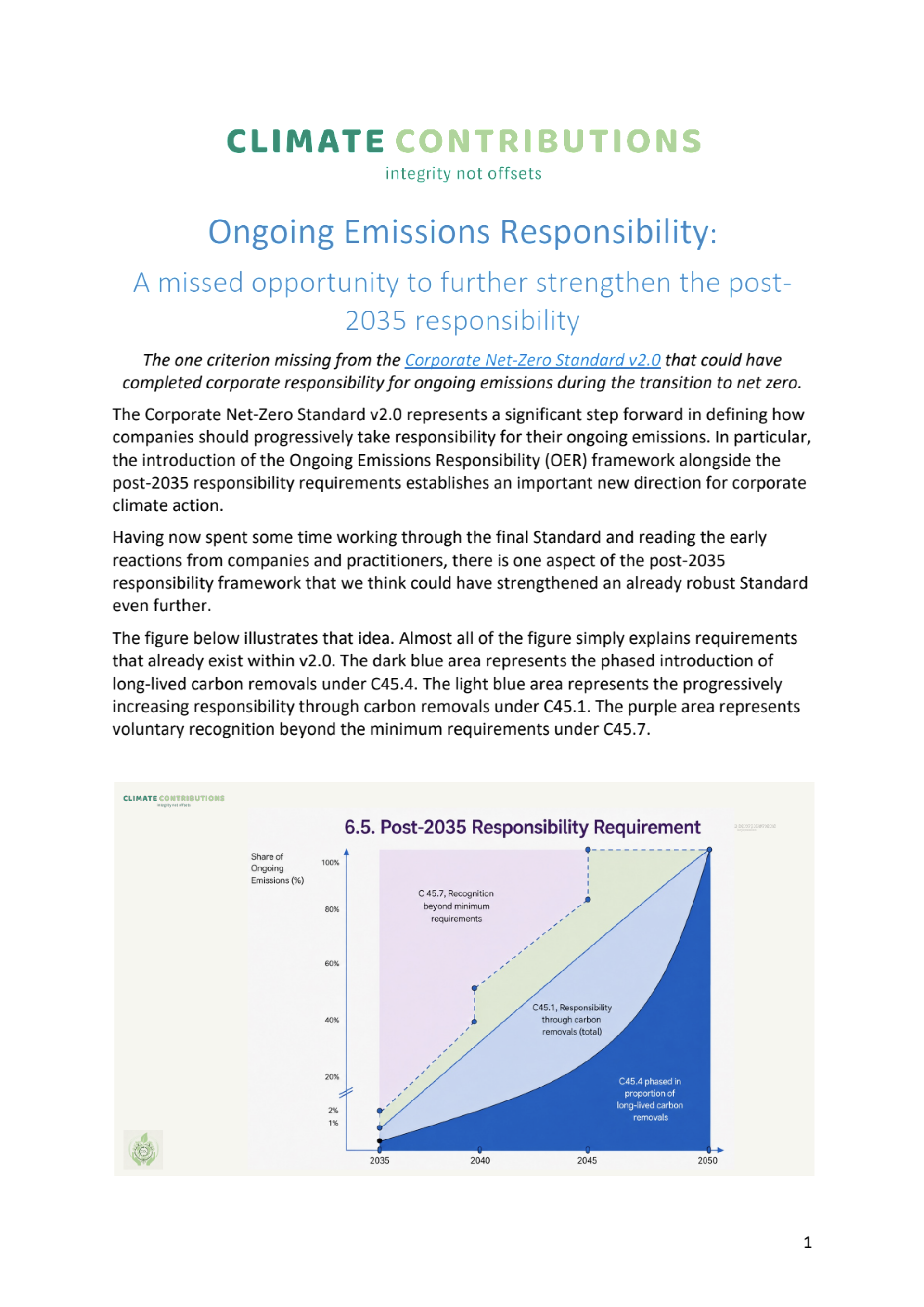
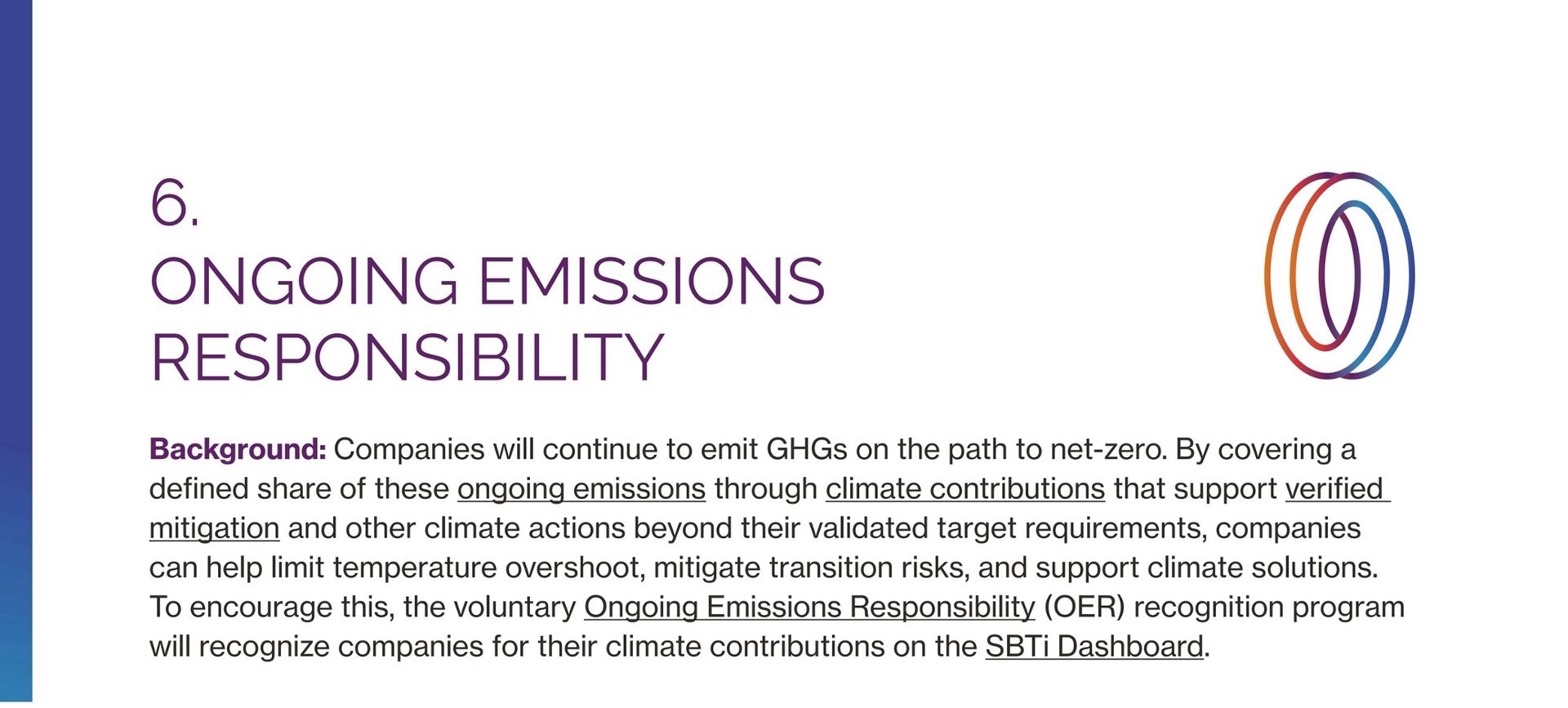
Its Ongoing Emissions Responsibility (OER) recognition rewards companies that take responsibility for the emissions they are still producing on the way to net zero. It funds verified mitigation and other climate action beyond their value chain, at three levels: Engaged, Advanced and Leadership. It is "a complement, not a substitute" for cutting a company's own emissions. Those outcomes are reported separately and never netted against the inventory.
That's a business case. It is four months old. It hasn't yet been given a chance.
This week Giulia Carbone of the World Business Council for Sustainable Development made exactly this point on Ecosystem Marketplace. [28] A WBCSD member survey found companies know OER well but are not yet acting on it. "The value to the company is ultimately in recognition," she writes. Companies "showing leadership on ongoing emissions responsibility will take courage", and those "testing, trying and addressing their ongoing emissions deserve to be celebrated."
Her article is titled "OER needs air cover, not just an obligation." She's right. If governments want to give companies air cover, they should give it to contribution claims.
The IETA paper takes the opposite route. It assumes compensation claims are the only ones companies will pay for. It treats litigation as the barrier. So it proposes protecting compensation claims from the courts.
The better route is to make contribution claims recognised and valued, so companies no longer need to make compensation claims at all. That route needs no change in the law.
Why this matters now
The Coalition's policy playbook is due at COP31. It will "outline a range of ways for policymakers to take action on the Coalition's Shared Principles". [6] This paper was commissioned by the Coalition and published only weeks before it. Its closing call is for governments "to seek convergence through The Coalition to Grow Carbon Markets" (p.13). It even suggests "the Coalition could work to develop a harmonised position" on how companies may use credits (p.23).
Put those pieces together:
- Shared Principles that allow credits to address "a portion of targeted emissions reductions" [3]
- a safe harbour that extends to "offsetting purposes" without defining which uses are eligible
- governments invited to recognise national pathways where SBTi doesn't fit
Together, these would give the use of credits toward decarbonisation targets something it has never had: the appearance of government backing.
It also lands at a sensitive moment for ISO 14060. The paper names the draft as "potentially a foundation for safe harbour claim-setting rules" (p.14). The draft already goes one step further than SBTi. It allows credits as "one possible remedial action" to "maintain or regain a claim" when a company misses an interim target. [5] If safe harbours are anchored to ISO claims, that remedial use becomes legally protected. And the pressure on the redraft will be to widen it.
Questions for the Coalition before COP31
- Will the playbook allow credits to count toward decarbonisation targets? If so, which "portion"?
- Will any safe harbour be anchored to SBTi v2 and ISO 14060, or to national pathways designed around them?
- Why should governments protect offsetting claims, rather than recognise the contribution claims that every jurisdiction already treats as safest?
- How does a safe harbour square with the Inter-American Court's call for "binding conditions to avoid practices such as greenwashing"?
- And where in the process were consumers, civil society and the people who brought these cases?
We support high-integrity carbon markets, and the finance they can bring to forests and developing countries. But integrity isn't something you can legislate into a claim after the fact. Make the claims credible, and they won't need a safe harbour.
Interested in others' views, particularly from those involved in the SBTi and ISO processes, the lawyers and NGOs who have brought these cases, and companies already making contribution claims.
Annex: How safe harbours have been used, and how they have fared
Safe harbours are not new, and they are not confined to any one legal system. The examples below show where they have been used to shield corporate statements from legal challenge, and what happened next.
1. United States: gun industry immunity (2005)
The Protection of Lawful Commerce in Arms Act bars most civil suits against gun makers and sellers for harm caused by someone else's criminal or unlawful misuse of a gun, and it ordered pending suits by victims and cities to be dismissed. Congress's findings called such suits "an abuse of the legal system". [29] Critics say it "has largely closed the courthouse doors to victims and municipal leaders", and repeal bills have been introduced in successive Congresses without success. [30] But the Act deliberately leaves marketing exposed. Its "predicate exception" allows suits against a maker or seller that knowingly broke a law applicable to the sale or marketing of guns. That is how the Sandy Hook families' claim against Remington, brought under Connecticut's unfair-trade-practices law, survived and settled for $73 million in 2022. [31] It protects companies from liability for what others do with their products, not from challenges to their own claims.
2. United States: forward-looking statements in securities law (1995)
The Private Securities Litigation Reform Act protects company forecasts from private securities claims where they are accompanied by "meaningful cautionary statements" and are not knowingly false. Congress passed it over a presidential veto. It has drawn sustained criticism from investor advocates and scholars, one of whom asked whether it was a "safe harbor for the innocent or modern day Port of Tortuga for the buccaneers of Wall Street". [32] It applies to forward-looking statements, not to claims about what a company has already done, and it excludes knowingly false statements.
3. United States: the SEC climate disclosure rule (2024)
The Securities and Exchange Commission's climate disclosure rule extended a similar safe harbour to transition plans, scenario analysis, internal carbon prices and targets. [33] The rule was challenged in the courts, and in March 2025 the SEC voted to stop defending it. [34] The safe harbour never took effect.
4. Australia: modified liability in climate disclosure law (2024)
Australia's mandatory climate disclosure regime includes "modified liability" for scope 3 emissions and scenario analysis during its first three years. Only the regulator, ASIC, can take action on those disclosures, and only for injunctions and declarations, not penalties. The Environmental Defenders Office argued that this "waters down ASIC's enforcement powers at a time when greenwashing is prolific" and removes the role third parties play in holding companies to account. [35] The protection is time-limited and covers estimates that are inherently uncertain, not marketing claims.
5. Canada: rolling back greenwashing provisions (2026)
In 2024 Canada amended its Competition Act to require environmental claims about a business to be substantiated "in accordance with an internationally recognized methodology", and allowed private parties to bring such claims to the Competition Tribunal. Bill C-15, which received Royal Assent on 26 March 2026, removed both for claims about a business or its activities. [36] Business groups welcomed the change. Environmental lawyers and civil society groups warned that it would "weaken the enforcement architecture necessary to meaningfully deter deceptive environmental claims". [37]
6. United States: "light" cigarettes (2008)
In Altria Group v. Good, cigarette manufacturers argued that federal law and the Federal Trade Commission's handling of tar and nicotine testing shielded their "light" and "lowered tar" claims from state consumer-fraud suits. The US Supreme Court disagreed. It held that the claims concerned "a duty not to deceive", and that where a pre-emption provision has more than one plausible reading, courts should "accept the reading that disfavors pre-emption". [38] Government involvement in the measurement method did not license a misleading claim.
Observations
The safe harbours that have endured tend to share three features. They protect statements about the future, not claims about what has already been achieved. They are limited in time or scope, or they preserve the regulator's role. And they exclude knowingly false or misleading statements. The proposal in the IETA paper would protect claims about outcomes, such as carbon neutrality or partial offsetting. It sets no time limit. And under its eco-label route, the state rather than the courts would settle what a claim means. The closest real-world precedent for that route, Australia's Climate Active scheme, discussed in the article above, is now being closed.
References
[1] Climate Contributions, "Reading the Play: How a WEF/KPMG Paper Sets Up the Coalition to Grow Carbon Markets' Playbook", LinkedIn, 1 October 2026.
[2] IETA, Unlocking Demand in Voluntary Carbon Markets through Safe Harbour Mechanisms: A Recommendation to Governments, commissioned by The Coalition to Grow Carbon Markets, October 2026. Page numbers refer to the printed pages. Announced in "IETA calls on governments to offer safe harbour to companies using carbon credits", 22 October 2026.
[3] Coalition to Grow Carbon Markets, Shared Principles for Growing High-Integrity Use of Carbon Credits by Companies and Other Buyers, November 2025.
[4] Science Based Targets initiative, Corporate Net-Zero Standard, Version 2.0, June 2026. See C25-C26 (target implementation), section 6 and C43 (Ongoing Emissions Responsibility), and Annex A.9.
[5] ISO, ISO/DIS 14060 Draft International Standard (net zero aligned organizations), June 2026, clauses 5.4 and 16.6.
[6] Coalition to Grow Carbon Markets, Policy Playbook announcement, 23 June 2026.
[7] VCMI, Claims Code of Practice, Version 3.0, April 2025, Box 1, p.14.
[8] SBTi, Evidence Synthesis Report Part 1: Carbon Credits, July 2024.
[9] SBTi, Corporate Net-Zero Standard V2: First Public Consultation Feedback Report, November 2025.
[10] SBTi, Corporate Net-Zero Standard V2.0: Second Public Consultation Feedback Report, June 2026.
[11] Climate Contributions, "ISO 14060 and the NO vote: separating the fair critique from the unsupported fix", LinkedIn, 3 September 2026.
[12] Trellis, "ISO members send net-zero draft back for revisions", 23 September 2026. See also ESG Today, "ISO's Proposed Net Zero Standard Fails Initial Vote Amid Record Feedback", 29 September 2026.
[13] IETA, Asia Climate Summit 2026 agenda, "Safe Harbour for Corporate Use of Carbon Credits Roundtable", 7 July 2026, Hong Kong Convention and Exhibition Centre.
[14] Al Jazeera, "Dutch court ruling considers national airline guilty of greenwashing", 20 March 2024.
[15] ESG Dive, "'Carbon neutral' Apple Watch not actually carbon neutral, says German court", August 2025.
[16] ABC News, "EnergyAustralia apologises over claims of 'greenwashing' with Go Neutral products", 19 May 2025.
[17] Inter-American Court of Human Rights, Advisory Opinion OC-32/25, Climate Emergency and Human Rights, 29 May 2025, paras. 347, 360 and 521, and section on the right of access to justice.
[18] UNECE, Convention on Access to Information, Public Participation in Decision-Making and Access to Justice in Environmental Matters (Aarhus Convention), Article 9(3), UK Treaty Series No. 24 (2005). The UK ratified in 2005; the European Community approved it in 2005.
[19] International Court of Justice, Obligations of States in respect of Climate Change, Advisory Opinion, 23 July 2025, paras. 282 and 428. Full text in International Legal Materials.
[20] Directive (EU) 2024/825 on empowering consumers for the green transition, 28 February 2024, Annex I point 4a; applies from 27 September 2026.
[21] Hogan Lovells, "On Hold: EU pulls the plug on Green Claims Directive", 1 July 2025.
[22] Ecojustice, Canadian Association of Physicians for the Environment, Équiterre, Greenpeace Canada and Centre québécois du droit de l'environnement, "Budget 2025: Don't water down Canada's anti-greenwashing rules", December 2025.
[23] RenewEconomy, "Parents for Climate put utilities on notice after landmark win against 'state sponsored greenwashing'", 30 May 2025.
[24] Environmental Defenders Office, "Questionable Climate Active certification scheme is coming to an end", 28 July 2026.
[25] Enviliance, "Australia Climate Active Carbon Neutral Certification to End 2027, Successor Scheme Consultation Open", August 2026. See also the DCCEEW announcement.
[26] The Fifth Estate, "Climate Active is closing, but what does this actually mean for the industry?", 30 July 2026.
[27] Nic Seton, "Parents took an energy giant to court over 'carbon neutral'. The government just scrapped the scheme that made it possible", The Point, 4 August 2026.
[28] Giulia Carbone (WBCSD), "OER needs air cover, not just an obligation", Ecosystem Marketplace, October 2026.
[29] Congressional Research Service, The Protection of Lawful Commerce in Arms Act: An Overview of Limiting Tort Liability of Gun Manufacturers, R42871, 20 December 2012.
[30] Center for American Progress, "Frequently Asked Questions About Gun Industry Immunity", 4 May 2021.
[31] Jacob D. Charles, "Sandy Hook Gun Settlement Marks a Turning Point", Bloomberg Law, 28 February 2022.
[32] "Private Securities Litigation Reform Act of 1995: safe harbor for the innocent or modern day Port of Tortuga for the buccaneers of Wall Street?", law review article (vLex).
[33] Deloitte, "Heads Up: Comprehensive Analysis of the SEC's Landmark Climate Disclosure Rule", March 2024, updated April 2024.
[34] Eversheds Sutherland, "SEC ends defense of climate disclosure rules", March 2025.
[35] Environmental Defenders Office, "New climate disclosure laws improve corporate accountability, with loopholes", 5 February 2024.
[36] KPMG Canada, "Changes to Canada's anti-greenwashing laws and business risk", April 2026.
[37] Environmental Justice and Sustainability Clinic, Osgoode Hall Law School, "Regulatory Retreat: How Bill C-15 Could Undermine Greenwashing Enforcement in Canada", 12 March 2026. See also CBC News, "Businesses welcome changes to Canada's greenwashing laws, but environmentalists aren't happy".
[38] Altria Group, Inc. v. Good, 555 U.S. 70 (2008), syllabus (Cornell LII).
A full PDF version of this piece is available for download here.
Ongoing Emissions Responsibility