What we are missing about the update to the Absolute Contraction Approach
This is a subtitle for your new post
The ACA update and the OER framework
The Science Based Targets initiative (SBTi) has recently updated its Absolute Contraction Approach (ACA), one of the core methodologies used to set corporate emissions reduction targets. The ACA determines the rate at which companies are expected to reduce their absolute greenhouse gas emissions over time in order to align with global climate goals.
The update has generated considerable debate. Some commentators argue that it results in a less demanding near-term decarbonisation pathway for certain companies, while SBTi maintains that the change improves consistency, implementation and target-setting practicality without weakening long-term net-zero ambition. Regardless of where one stands in that debate, the discussion has focused almost entirely on the emissions reduction pathway itself.
What has received far less attention is how this adjustment interacts with another major innovation currently being introduced through the draft Corporate Net-Zero Standard (CNZS v2): the Ongoing Emissions Responsibility (OER) framework.
That interaction matters because the ACA determines how quickly emissions are reduced, while OER addresses how companies take responsibility for the emissions that remain while that transition is underway. Seen through that lens, the significance of the ACA update may extend beyond target-setting methodology and into the evolving architecture of corporate climate responsibility itself.
Historically, SBTi was largely interpreted as a reduction-only framework
Reduce emissions in line with a science-based pathway, and deal with the residual emissions that remain at the point of net-zero.
Whether that interpretation was entirely accurate is debatable. But it broadly reflected how the system was understood.
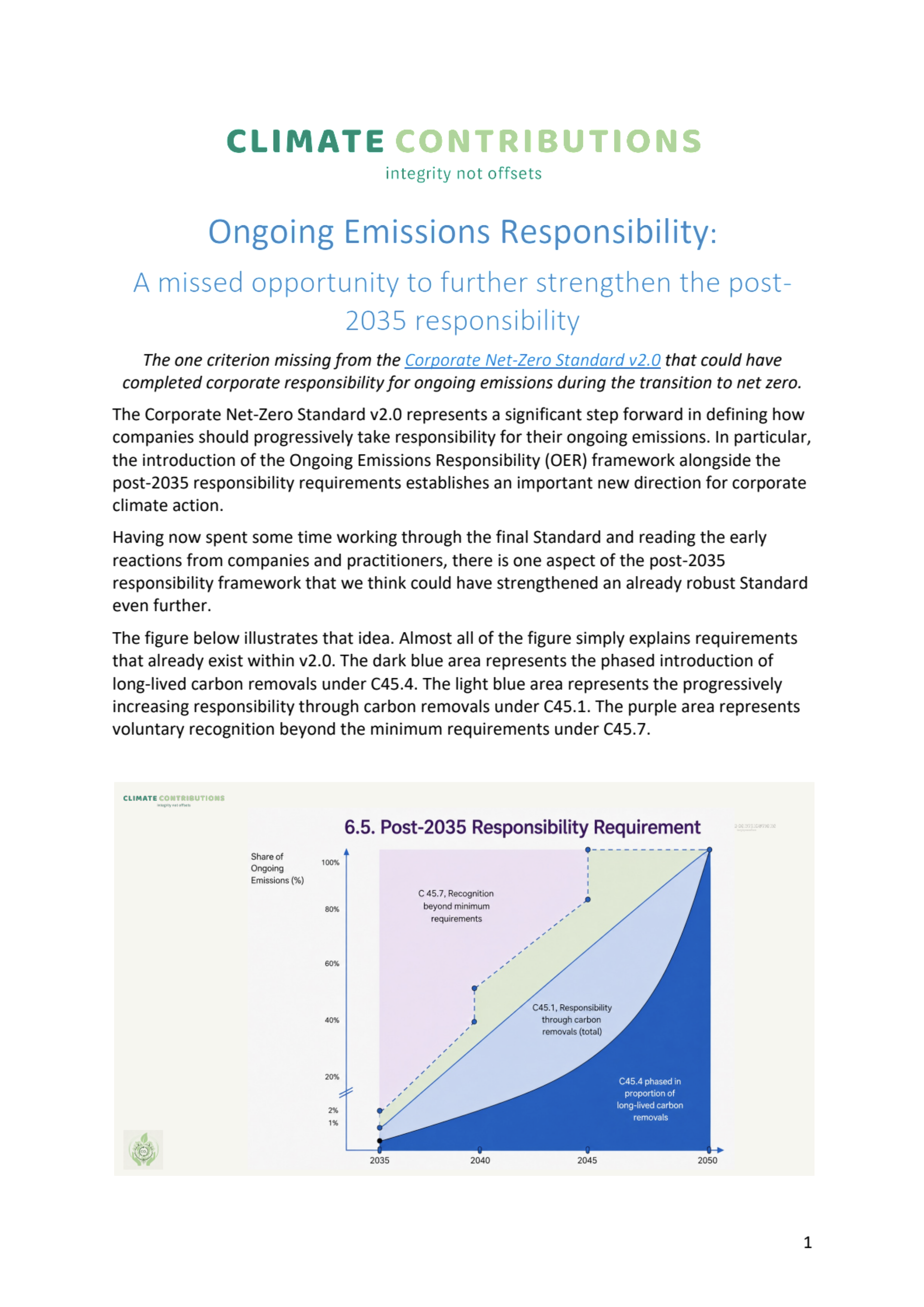
There is now a second mechanism doing real work: the Ongoing Emissions Responsibility (OER) framework.
Introduced in CNZS v2, OER operates alongside the emissions reduction pathway:
- the ACA governs how fast emissions come down
- OER governs how companies account for the emissions that remain while that is happening
That’s a structural change. Not a tweak.
What the ACA means in that context
The ACA adjustment looks, in practical terms, like a recalibration of the near-term trajectory. Less front-loaded, more spread over time. Whether you see that as pragmatic or problematic is a separate question.
But there is a consequence that deserves attention.
If the revised ACA results in a more gradual near-term decarbonisation pathway for some companies, then a larger volume of emissions will remain on the pathway during the transition period than would otherwise have been the case.
Those emissions are not outside the system. They are inside it.
Which raises a more interesting question than simply asking whether ambition has increased or decreased:
what happens to those emissions while they remain?
OER is designed to address that question
OER is often described as a voluntary add-on. That’s not how it functions in the draft.
It is the only component of the draft Corporate Net-Zero Standard that explicitly engages with the reality that companies will continue to emit while transitioning towards net-zero.
And crucially, it does that without relying on compensation logic.
That’s the real innovation.
Because it creates a category of action that is:
- not abatement
- not neutralisation
- not offsetting
But still recognised as part of credible net zero action.
That space has never previously been formalised within the SBTi framework.
The interaction is not subtle
If pressure on the abatement pathway is eased in the near term, even modestly, the challenge does not disappear.
A larger volume of emissions remains on the pathway for longer. Those emissions become part of the transition journey rather than being eliminated immediately.
Within CNZS v2, OER is the only mechanism specifically designed to recognise responsibility for those emissions while they remain ongoing.
That is why the relationship between ACA and OER matters.
Why OER becomes more central, not less
This is not primarily a question of increasing demand in a narrow market sense. It’s more fundamental than that.
The ACA defines the pace of transition.
OER defines how responsibility is exercised during that transition.
If emissions remain on the pathway for longer, the importance of demonstrating responsibility for those emissions increases.
And OER is the only mechanism within the draft Standard designed for that purpose.
There’s also a political economy dimension
SBTi is trying to hold two things together:
- maintaining scientific credibility
- maintaining corporate participation
The ACA update speaks, at least in part, to the second objective.
OER helps protect the first.
Not because it substitutes for emissions reductions, but because it creates a framework through which companies can demonstrate responsibility for emissions that remain while reductions are still being delivered.
That is not an accidental feature of the architecture. It is one of its core design principles.
What much of the current commentary is missing
Most discussion of the ACA update treats ambition as though it resides entirely in the reduction pathway.
Under the previous paradigm, that was a reasonable assumption.
Under CNZS v2, it is no longer sufficient.
Corporate climate ambition is increasingly expressed through two separate questions:
- how quickly emissions are reduced
- and how seriously companies take responsibility for the emissions that remain
The first question is governed by ACA. The second is governed by OER. Focusing on one while ignoring the other only tells part of the story.
Where this leaves us
If the ACA adjustment results in a more gradual near-term trajectory for some companies, then more emissions may persist along the pathway for longer.
That’s not the end of the story. It’s the starting point.
Because the integrity of the system increasingly depends on whether those emissions are:
- ignored
- compensated
- or addressed through credible forms of ongoing responsibility
OER is the mechanism that helps determines which of those outcomes dominates.
Bottom line
The ACA update does not, by itself, tell us whether the overall system has become stronger or weaker. What it does tell us is that the architecture of corporate climate action is evolving.
The reduction pathway remains essential.
But it is no longer the whole story.
As CNZS v2 develops, OER is becoming the mechanism that addresses a reality every net-zero pathway must confront:
emissions continue while the transition is underway.
Ongoing Emissions Responsibility