ISO 14060 and the NO vote: separating the fair critique from the unsupported fix
This is a subtitle for your new post
Alexia Kelly runs the Carbon Policy and Markets Initiative at the High Tide Foundation, and sits on the oversight bodies of both the Integrity Council for the Voluntary Carbon Market and the Voluntary Carbon Markets Integrity Initiative. Over the past fortnight she has published two LinkedIn posts recommending a NO vote on ISO/DIS 14060 Net Zero Aligned Organizations. Most of the first post is a fair critique of a genuinely rough draft. Buried in the second is a different kind of request, and it is the one worth pulling apart on its own: carbon credits, she argues, should be allowed to count toward Scope 1, 2 and 3 emissions targets.
Where the critique is fair
A voluntary standard that requires companies to publish phase-out schedules, asset-stranding risk and cash-flow implications inside their core financial planning documents, as Clause 9 currently does, is not going to clear legal and risk review at most companies. A standard only the largest, best-resourced firms can operationalise is not much of a standard at all. Five separate target types, each carrying its own governance and assurance burden, is genuine over-engineering, particularly where they overlap. Energy efficiency, for instance, is already a subset of Scope 1–3 performance. And "a competent person or party" is a considerably weaker verification bar than the independent, accredited third-party verification that CORSIA, Article 6.4 and the ICVCM's own Core Carbon Principles already require.
None of that is an argument for letting credits count toward targets. It is just good drafting advice, and ISO's Technical Committee should take it.
The line that matters
The line worth scrutinising more closely is this one, from Kelly's second post: "Both supply chain-tied and global mitigation market-based instruments (in current parlance ECCs and carbon credits) should be allowed to count towards specified thresholds of Scope 1, 2, and 3 targets." It sits as one item among ten, wedged between simplification requests that are hard to argue with. It deserves to be pulled out and judged on its own terms.
What the evidence actually says
When the SBTi Board tried to open this exact door in April 2024, without its own technical council's sign-off, the backlash was immediate. The UN's own High-Level Expert Group on Net-Zero Commitments had already concluded that credits "cannot be counted toward a non-state actor's interim emissions reductions." SBTi's staff then did the thing that arguably should have happened before the Board statement, not after it.
Two evidence documents came out of that process in July 2024. The broader one, an Evidence Synthesis Report drawing on submissions across several confidence tiers, concluded that "various types of carbon credits are ineffective in delivering their intended mitigation outcomes," and flagged clear risk that corporate offsetting could hinder the net-zero transformation and reduce climate finance. The narrower one, an independent systematic review restricted to peer-reviewed academic literature, screened over ten thousand articles and found five, maybe six, rigorous enough to include at all. It called the resulting evidence base negligible.
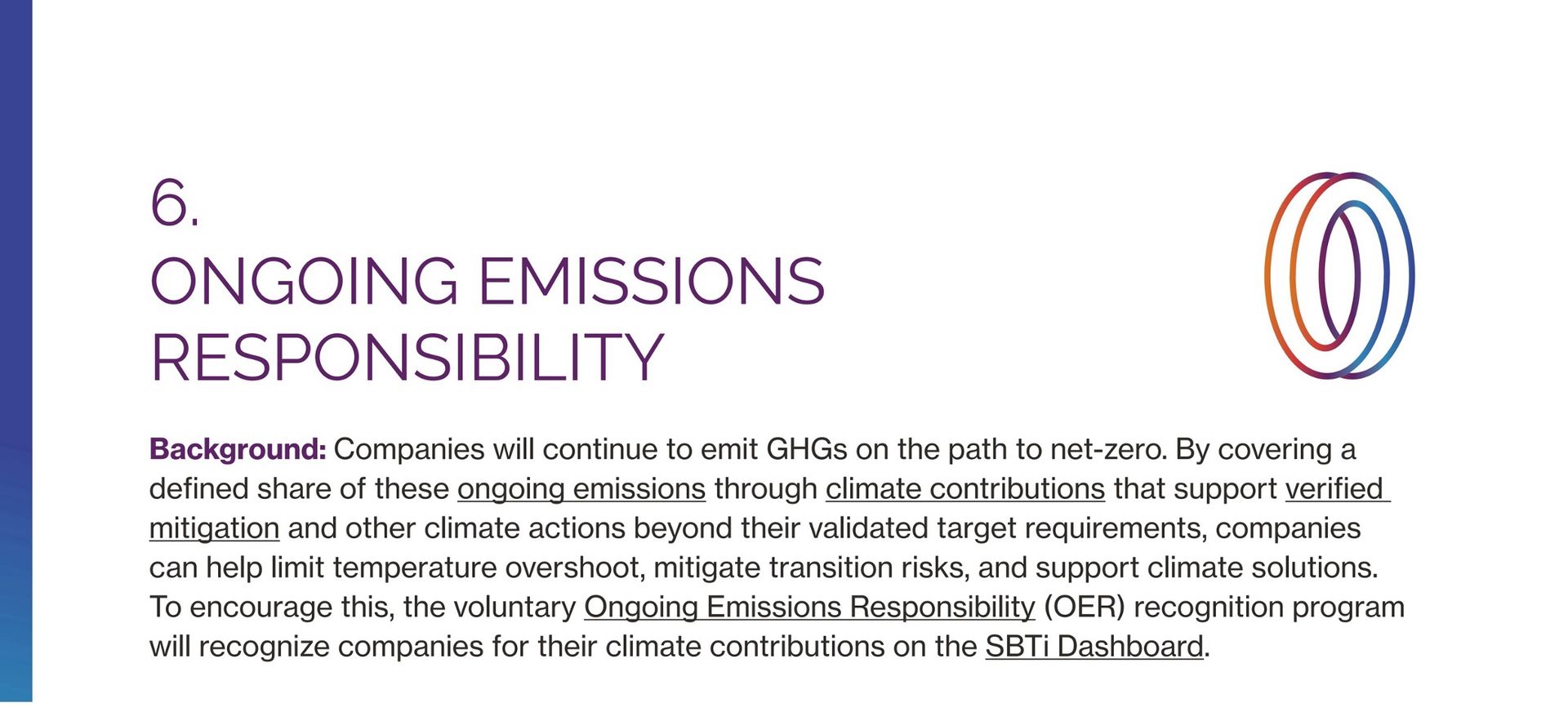
Where SBTi's own thinking has actually landed is more interesting, and more useful. The Corporate Net-Zero Standard V2.0, released this June and effective from February 2027, does not leave the question to inference. Chapter 5 sets the baseline: "Changes in the physical GHG inventory shall constitute the basis for any emissions reduction claims." Credits never touch that inventory, so they cannot touch the claim. A company that underperforms against its target is recommended to buy removals, but the standard is explicit that "such removals shall not be counted toward target progress." Where credits do fund mitigation outside the value chain, the standard gives that its own name, a "system contribution claim," and limits it accordingly: the company may say only that it is "contributing to the decarbonization of the systems in which the company's value chain activities are embedded," never that its own inventory has moved. Alongside all of that sits a separate, voluntary track, Ongoing Emissions Responsibility, for funding verified mitigation beyond a company's target requirements. SBTi's Board Chair, Francesco Starace, describes it as "a complement to reducing your own emissions, not a substitute for it."
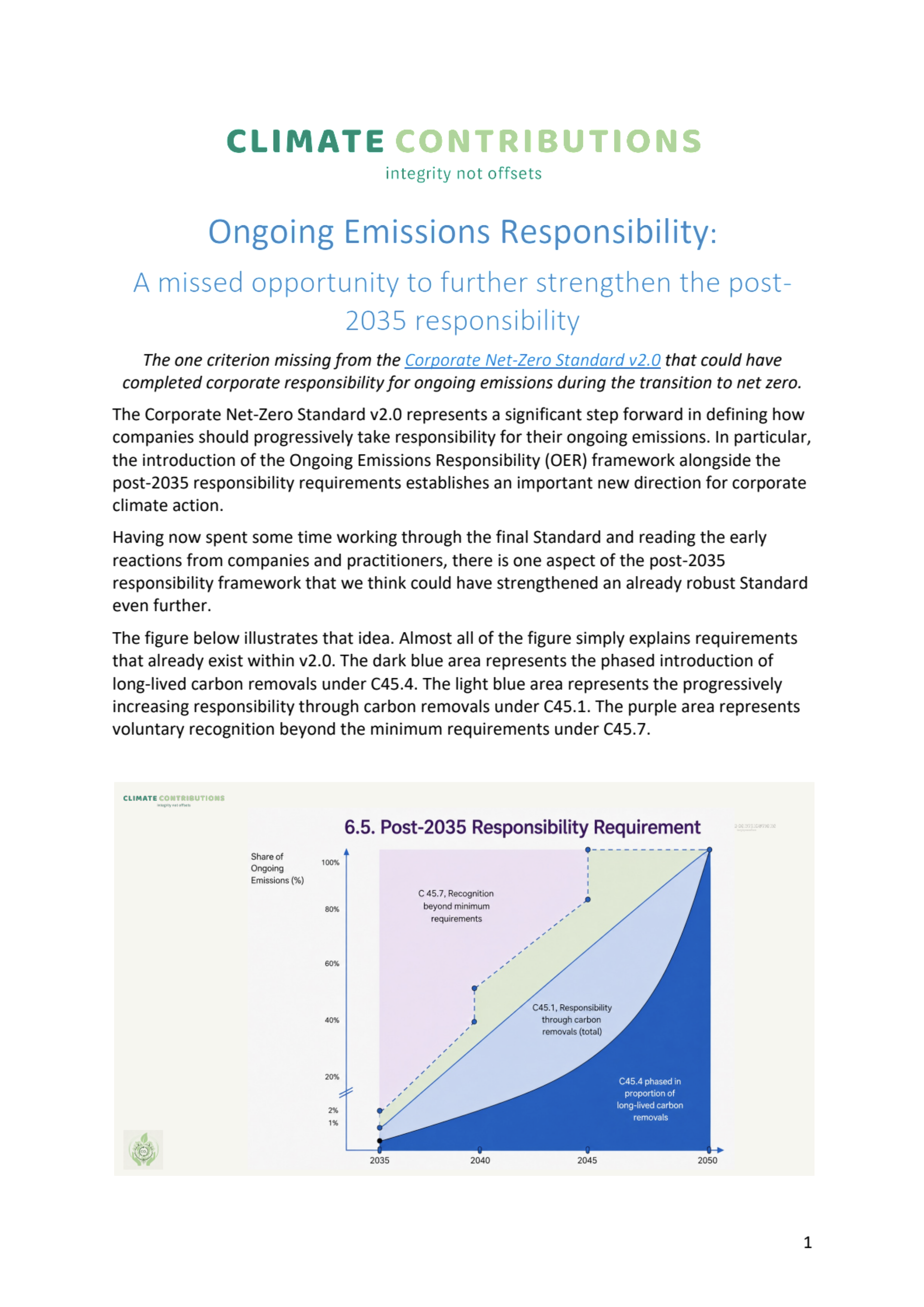
That is essentially the Ongoing Emissions Responsibility distinction we have written about on this site before: taking responsibility for what has not yet been eliminated is a different act from claiming it has been cancelled out. SBTi has not just floated that distinction. It has finalised it, written into a released standard rather than a consultation draft.
VCMI's own rules do not support it either
This is the part that should give ISO's Technical Advisory Group the most pause, given who is making the request. VCMI's Claims Code of Practice, the framework Kelly's own initiative helps govern, says it twice. "Carbon credits cannot be counted towards the achievement of within-value chain emission reduction targets." And later: credits "are not counted towards the internal emissions reductions that a company undertakes to meet decarbonization targets." The Silver, Gold and Platinum tiers reward credit retirement only as mitigation beyond the value chain, layered on top of a science-aligned target already being met. Never a substitute for one.
Even VCMI's one real carve-out for Scope 3, the Scope 3 Action Code of Practice launched at the end of April this year, is considerably narrower than what Kelly is asking ISO to adopt. It caps credit use at 25 per cent of a company's total Scope 3 emissions in any given year, requires full gap-matching, and sets a hard 2040 deadline to close that gap through real reduction. And even that bounded, time-limited exception drew criticism at launch. NewClimate's Thomas Day warned it "risks dialling back the already insufficient levels of corporate climate ambition" and could let laggard competitors "exaggerate their own efforts" against genuine climate leaders. Carbon Market Watch's Lindsay Otis Nilles was more direct: VCMI, she said, "risks undermining its own credibility by allowing companies to present themselves as climate leaders while, in reality, falling behind on their commitments."
So the outer edge of what the VCMI is prepared to defend is a capped, gap-matched, deadline-bound exception for one scope, and a contested one at that. Full target-counting across all three scopes sits well outside that edge. It is not a modest extension of flexibility VCMI already allows. It is a different proposal altogether.
The empirical case is thinner than it looks
The study usually reached for here is the 2023 Forest Trends and Ecosystem Marketplace finding that companies buying credits are 1.8 times more likely to be decarbonising year over year, and 3.4 times more likely to hold an approved science-based target. It is a real dataset, 7,415 companies, $110 trillion in assets. But the paper itself says the relationship is correlational, and credits made up roughly 2 per cent of those companies' total emissions. Firms that are already climate leaders for other reasons are also the firms most likely to be buying credits. That is not evidence the credits caused the leadership.
A more recent Carbon Market Watch analysis, published last November and drawing on Max Planck Institute research, goes further and finds no proven causal link at all, with some evidence pointing the other way: heavy credit purchasing can crowd out internal reduction effort through something close to moral licensing. The empirical pillar under "credits accelerate real decarbonisation" is thinner than the campaign built on top of it.
The argument moved because the evidence didn't
Two processes have now actually tried to answer this question properly, and both were run by people with every reason to want credits to succeed. SBTi commissioned the most rigorous review this question has had anywhere, an evidence synthesis and an independent academic literature review, and when its own Board tried to jump ahead of that process in 2024, its own staff's findings overruled it. VCMI, an initiative built by and for market participants, wrote the opposite conclusion into its foundational Claims Code instead of the one Kelly wants. Neither of those was a hostile audience. Both looked at the evidence and landed on no.
That has not ended the push to get credits counted toward targets. It has just moved off the ground where it lost.
On the ISO side, that shows up exactly the way it does in Kelly's post: as one line inside an otherwise reasonable ten-point list, the kind of item that gets waved through alongside genuine drafting fixes if nobody stops to pull it out and look at it on its own. On the government side, it shows up as momentum instead of an argument. The Coalition to Grow Carbon Markets has published three documents since COP30, Shared Principles, a Plan of Action, and a Programme of Work for 2026, without ever answering the one question that matters here. Principle A of the Shared Principles allows companies to retire credits against remaining emissions, "which may include a portion of targeted emissions reductions," and/or for action above and beyond targets. Which portion, under what conditions, or how that squares with a target at all is still not stated anywhere in the two documents that followed. In June, at London Climate Action Week, the Coalition announced that a policy playbook is coming, timed for release at COP31, meant to tell governments how to act on those same Shared Principles. In August it added Turkiye, Ghana and Luxembourg, taking its membership to fourteen governments.
A playbook is meant to tell policymakers how to implement a position. You cannot implement a position you have never stated. An organisation that has spent a year publishing on exactly this topic, and is now moving straight to implementation guidance while the underlying definitional question sits untouched, is not being vague by accident. Recruiting governments and shipping documents is easier than winning an evidence review, and it produces the same result without ever having to defend it in the open the way SBTi did.
Where credits do belong
None of this means credits have no role. ISO should not let anyone talk it into that position either. It means credits belong somewhere else in the standard than where Kelly is trying to move them.
We have made this argument before, from the other direction, in our Explainer on Clause 11.3.3 of this same draft. That clause sets up an emissions-linked climate finance mechanism, close in logic to SBTi's own Contribution Budget Approach, and it is fundamentally contribution-oriented: organisations recognise their remaining emissions still occur, and finance additional mitigation alongside reducing them, rather than claiming the emissions have been cancelled out. Our concern with Clause 11.3.3 is that Note 3 then muddies this by treating ISO 14068 carbon neutrality as an apparently equivalent pathway, when, as we wrote at the time, "contribution approaches and compensation-based carbon neutrality claims rest on different foundations."
Kelly's proposal is a version of the same error, applied to a different clause. Ruling credits out of target accounting in Clause 5.4 is not the standard failing to give credits a role. It is the standard, correctly, refusing to let a compensation claim disguise itself as target progress. The role credits should have, funding real mitigation for emissions a company has not eliminated yet, disclosed transparently, verified independently, never described as offsetting or neutrality, is a contribution claim. Nothing in Clause 5.4 stops ISO from spelling that out properly in the next draft. That is the fix worth pushing through the U.S. TAG. Not letting credits back into the target maths, but giving them a clearly defined, rigorously audited home as a responsibility mechanism, kept separate from the target itself.
Conclusion
It is also worth being honest about why this particular fix keeps resurfacing. High Tide Foundation's Carbon Policy and Markets Initiative sits inside a network of organisations, including a carbon-credit marketplace its founder co-founded, whose value proposition depends on credits keeping a direct role in target compliance rather than only funding mitigation alongside it. That does not make everything in Kelly's post wrong. Several of her points are right, and ISO should act on them.
But the specific request to count credits toward Scope 1–3 targets is not a science-based correction to an overcautious draft. It runs against a conclusion SBTi, the UN's own expert group, and, on paper, VCMI itself have all already reached, and it repeats a tension we think ISO has already got right elsewhere in this same standard. ISO does not need to relearn that lesson from scratch, and it should not unlearn it here either.
A full PDF version of this piece is available for download here.
Ongoing Emissions Responsibility